
4 min readAuravea Editorial
Clean Beauty, Scientifically Made: Inside Auravea Healthcare Pharmatech LLP’s Cosmetic Innovations
Clean, science-driven skincare that nourishes, protects and supports lasting results — and why stability testing decides whether any of that survives to the shelf.
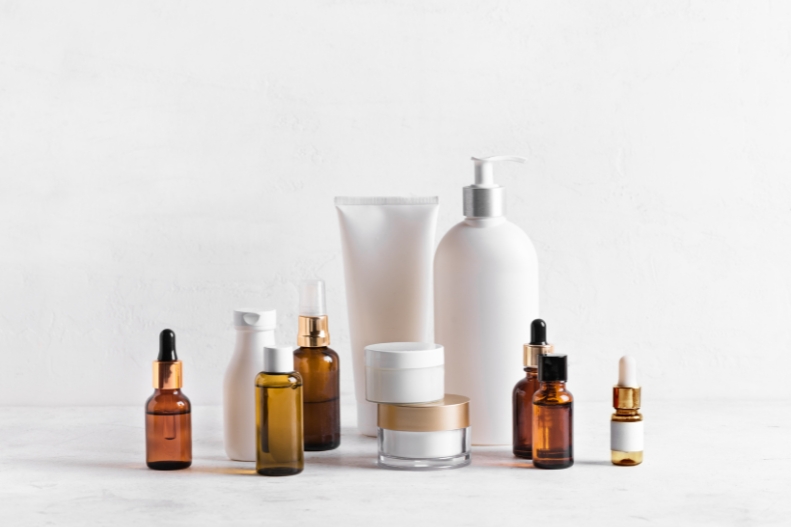
"Clean beauty" is a phrase that has been asked to carry more weight than it can hold. It has meant free-from lists, it has meant naturally derived, it has meant whatever a marketing team needed it to mean that season. Used carelessly, it describes nothing at all.
We use it in a narrower sense: a formulation whose ingredients are there for a reason we can defend, at a concentration that does something, in a base that keeps them intact and a pack that keeps them safe. That definition is testable. Most of the interesting work in cosmetics happens in the gap between a formulation that meets it on paper and one that still meets it eighteen months later.
An active is only as good as its concentration
Ingredient lists are ordered by concentration, but they do not state it. That gap is where a great deal of cosmetic marketing lives — an active named prominently on the front of the carton, present in the formula at a fraction of the level any study used.
We formulate to the concentration the evidence supports, or we leave the active out. This is less a moral position than a practical one: an ingredient below its effective threshold contributes cost, formulation risk and a claim that consumer results will eventually contradict. There is no version of that trade that works out.
An active present below its effective concentration is not a gentler version of the product. It is a more expensive version of the base.
Stability is where formulations actually fail
Vitamin C is the honest example. Ascorbic acid is genuinely effective and genuinely difficult: it oxidises on contact with air, degrades with light and heat, and browns visibly as it goes. A serum that is beautifully active in the lab can be substantially degraded by the time it reaches a bathroom shelf in a warm climate.
Solving that is a combination problem — the derivative or stabilised form chosen, the pH the base is held at, the antioxidant system supporting it, and the packaging that excludes air and light. Change any one of those and the others have to be re-evaluated. This is why our stability work runs in the actual production packaging rather than in a laboratory jar: the pack is part of the formulation, not a container the formulation is poured into afterwards.
What stability testing has to answer
- Does the active remain at its claimed level across the intended shelf life?
- Does the emulsion hold, at temperature extremes and through freeze-thaw cycling?
- Does the formulation interact with the pack — absorption, leaching, or seal failure?
- Does the preservative system still hold after challenge testing?
Preservation is a safety system, not an ingredient to remove
The pressure to shorten preservative lists is real, and some of it has been useful — it has driven better systems. But a water-containing cosmetic without effective preservation is a growth medium that someone will apply to broken skin or near their eyes. Challenge testing exists to prove the system holds against deliberate inoculation, and it is not optional.
The interesting work is in building preservation that is both effective and well tolerated: choosing systems appropriate to the pH and packaging, supporting them with formulation architecture such as low water activity or airless dispensing, and proving the result rather than assuming it.
Working with founders and with established brands
A first-time founder and a brand moving its production have different anxieties. The founder usually needs to know what is realistic — what a formulation costs, what minimum order sizes mean for cash, which claims the data will actually support. The established brand needs to know that a transfer will not change how the product feels, because their customers will notice immediately.
In both cases we would rather have the difficult conversation early. If a brief asks for an active at a concentration that will not stay stable in the requested pack, saying so at the brief stage is cheaper for everyone than discovering it in month nine of a stability study.
What clean should mean
Clean beauty, done properly, is not about what has been removed. It is about being able to explain why every remaining ingredient is present, at what level, and what evidence supports it — and then having the stability and safety data to show the product still works at the end of its life, not only at the start.
If you are developing a range or moving an existing one, our cosmetics division will tell you what it takes to make it — including where a formulation needs rework before it is worth manufacturing.